

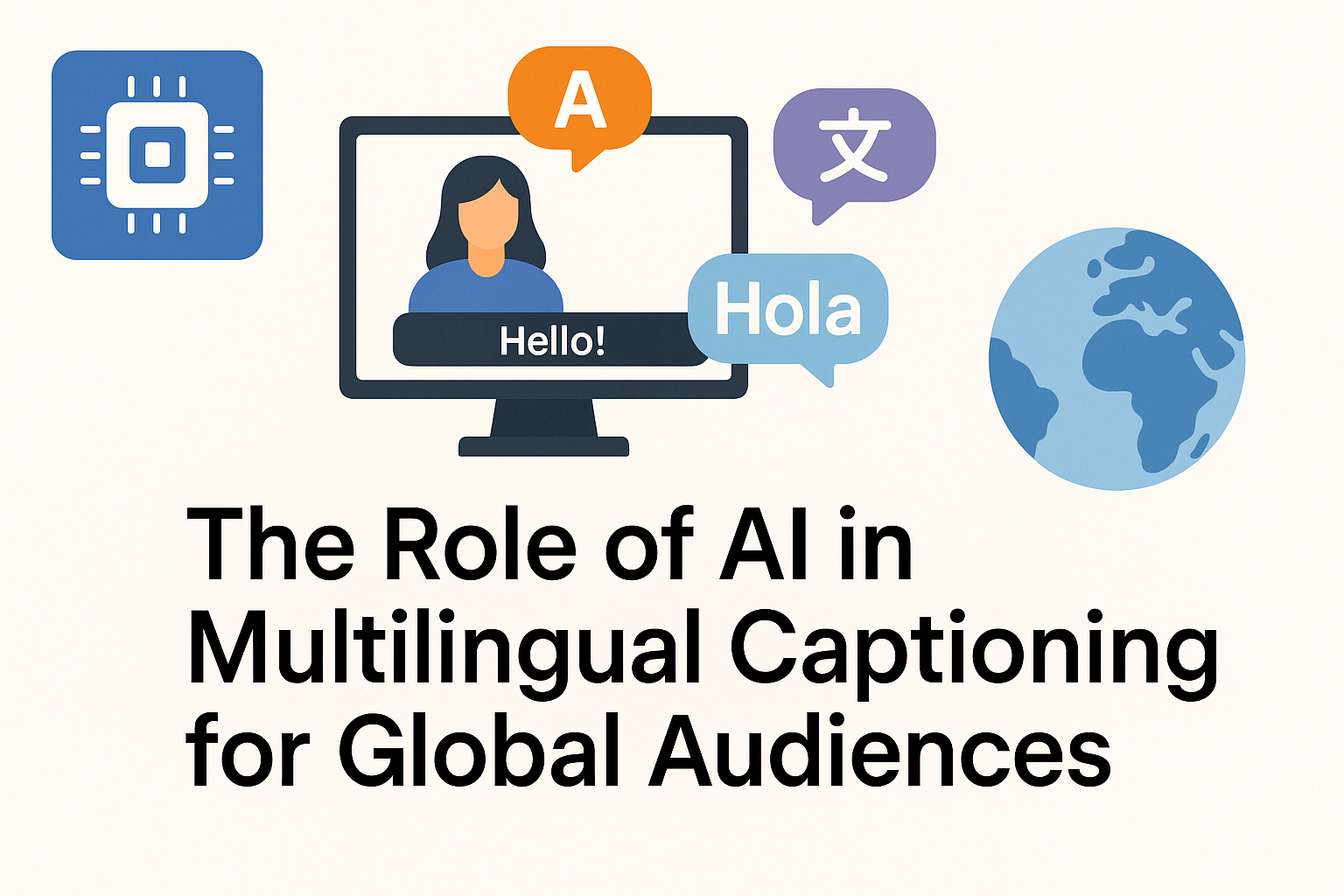
Video content now dominates how people consume digital media across the global. Every scroll, click, and stream is filled with visuals that connect audiences instantly. Yet, language often stands as an invisible wall, limiting how far stories and messages can travel.
AI-driven multilingual captioning is changing that, helping brands, educators, and creators communicate seamlessly across cultures and languages. This blog explores how artificial intelligence transforms captioning technology, its role in breaking language barriers, and its growing impact on global accessibility and audience engagement.
The Need for Multilingual Captioning in Global Media
The need for multilingual captioning in global media arises from the rapid growth of video consumption across international borders. As audiences from different regions engage with online content, language diversity becomes a major barrier to understanding.
Creators often face challenges in reaching wider audiences due to linguistic differences, limiting the impact of their work. Multilingual captions solve this by making content accessible to viewers who speak different languages.
They enhance inclusivity for people with hearing impairments and boost engagement by helping users follow content clearly. In today’s digital world, captions are not just a convenience but a necessity for truly global communication.
How AI Powers Multilingual Captioning?
AI powers multilingual captioning by using advanced systems that listen, understand, and translate speech in real time. It starts with Automatic Speech Recognition (ASR), which converts spoken words into accurate text by identifying speech patterns, accents, and background sounds.
Then, Natural Language Processing (NLP) helps the AI understand context, tone, and intent behind every word. Once the text is clear, Machine Translation (MT) takes over to translate captions into multiple languages while keeping the natural meaning intact.
This process also adapts slang, idioms, and cultural nuances, making conversations and videos more accessible and human-like across different regions and languages.
Benefits of AI-Generated Multilingual Captions
- AI-generated multilingual captions offer faster and more cost-efficient captioning, reducing manual effort and turnaround time.
- They ensure improved accuracy and contextual translation, as advanced AI models understand tone, slang, and regional language variations.
- Additionally, they enhance user engagement and increase watch times by allowing audiences to follow content easily in their native language.
- They also promote accessibility for viewers with hearing impairments, ensuring inclusivity across platforms.
- Furthermore, they simplify global content distribution, helping creators and brands reach diverse audiences effortlessly without the need for separate localized versions.
Real-World Applications Across Industries
Real-world applications of multilingual captioning are transforming industries globally. In entertainment and OTT platforms, it enables instant subtitle translation, letting audiences stream content in their preferred languages.
In education, online learning platforms now teach students across borders through real-time multilingual captions. Corporate training benefits as teams from different regions can understand the same material effortlessly.
Marketing uses captions to help brands connect emotionally with local audiences through regional language videos. On social media, creators reach larger audiences by adding multilingual subtitles to their short videos, allowing people from various countries to enjoy and engage with their content easily.
Challenges in AI-Based Multilingual Captioning
AI-based multilingual captioning faces major challenges in accuracy and timing. Handling regional dialects and language nuances is complex, as words often change meaning across regions. Maintaining synchronization between audio and translated text also becomes tough when speakers talk fast or use mixed languages.
Additionally, quality control demands human review to ensure cultural and emotional accuracy. Literal translations often fail to capture tone or intent, making contextual understanding essential. These challenges highlight the fine balance AI must achieve between automation, linguistic depth, and real-time precision to deliver captions that feel natural and truly global.
How RenderCut Simplifies Multilingual Captioning?

RenderCut is an AI-driven video captioning platform that makes multilingual video creation effortless. It automatically handles transcription, translation, and subtitle design in one workflow. Using advanced AI models, RenderCut ensures high accuracy and supports over 40 languages, allowing global audiences to understand content seamlessly.
Its automatic multilingual support helps videos adapt to any language, while customizable caption styles maintain brand consistency and visual appeal. For creators and marketers, RenderCut simplifies global publishing by removing manual editing and language barriers, helping videos reach diverse audiences with precision, speed, and clarity, making every message accessible across the world.
Future of AI in Multilingual Video Accessibility
The future of AI in multilingual video accessibility is shaping a world where everyone can enjoy content in their preferred language without barriers. Real-time voice recognition and generative AI now enable instant translation and dubbing, allowing videos to adapt to global audiences effortlessly.
Adaptive captions are becoming smarter, automatically adjusting to the viewer’s language settings and speech patterns for better readability. Furthermore, AI-driven content localization is making videos culturally relevant by fine-tuning tone, expressions, and regional nuances. As these technologies evolve, they are turning video accessibility into a seamless, inclusive experience for audiences across languages and borders.
FAQs
What is multilingual captioning?
Multilingual captioning means displaying video subtitles in multiple languages at once. It helps viewers worldwide understand and engage with content without language barriers, improving accessibility and retention.
How does AI improve caption translation accuracy?
AI improves translation accuracy using Natural Language Processing (NLP) and neural networks that learn language patterns. Studies show AI-based captioning achieves over 95% accuracy in context recognition.
Can RenderCut translate captions in real-time?
RenderCut supports real-time caption translation by using AI-powered speech recognition and instant subtitle generation. It ensures synchronized captions across multiple languages with minimal delay for live and recorded videos.
Why are captions important for global audience engagement?
Captions increase global engagement by 80%, as reported by Meta. They allow users to watch videos without sound, understand content in their language, and improve overall viewer retention and comprehension.
Which industries benefit most from multilingual captions?
Industries like education, media, entertainment, corporate training, and e-learning benefit most. Global brands use multilingual captions to connect with diverse audiences and ensure inclusive communication.
Conclusion
AI-driven multilingual captioning is redefining how the world consumes content. By automatically translating and synchronizing captions across multiple languages, it ensures that videos are accessible and engaging to diverse global audiences.
This transformation empowers creators to connect with viewers beyond linguistic boundaries. With advanced tools like RenderCut, producing multilingual captions becomes fast, seamless, and accurate. Try RenderCut today and make your videos speak every language because global reach starts with inclusive communication.