
Why Viewers Scroll Away in the First 3 Seconds (And How to Fix It)
 RenderCutCreator Tips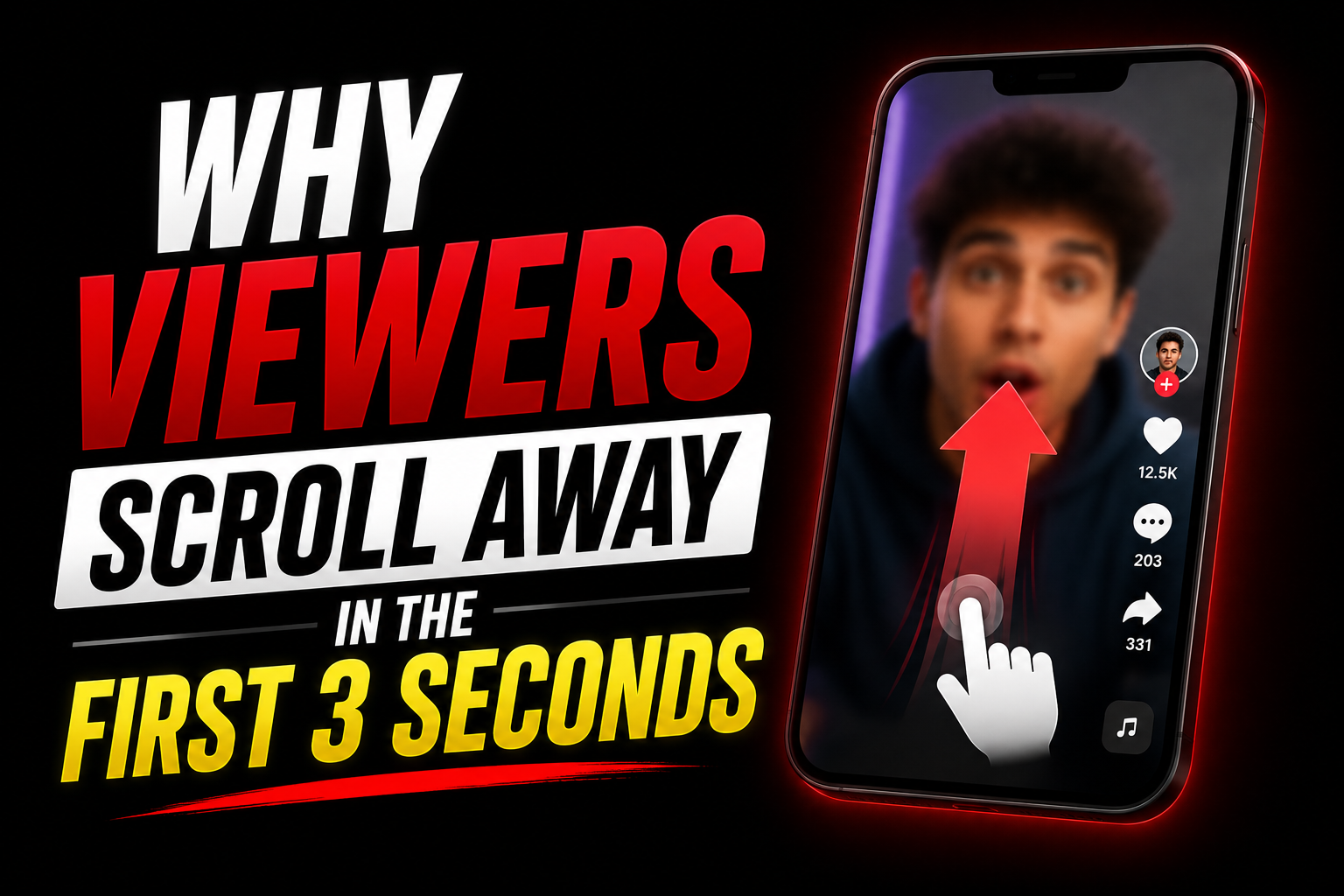
71% of viewers decide whether to watch or scroll within the first 3 seconds of a video. Not 10 seconds. Not 5. Three.
That is the window you get. If nothing on screen grabs attention in that moment, the viewer swipes and your video never gets the chance to deliver its message. The algorithm sees the early drop-off, stops promoting the content, and the video dies with low reach regardless of how good the rest of it was.
I spent weeks studying my own retention graphs and the pattern was painfully clear. My best content was being abandoned before the core message even started. The hooks were too slow, the first frame was too generic, and the opening captions were just transcriptions of whatever I said first instead of attention-designed text.
This guide covers exactly why viewers scroll away, the psychology behind the 3-second decision, and the hook framework that fixed my retention problem.
What this guide covers:
- Why the first 3 seconds are the only seconds that matter for distribution
- The 6 biggest reasons viewers scroll away
- The psychology of attention and how the brain decides to stay or leave
- 4 hook types that actually stop the scroll
- How captions impact the 3-second decision
- A step-by-step hook framework you can apply immediately
1. Why the First 3 Seconds Decide Everything
The first 3 seconds of a video are not creative space. They are economic space.
When your reel appears in someone’s feed, the platform makes a micro-investment: it shows your content to a small test audience. If those viewers pause, watch, and engage, the algorithm invests more by pushing the video to a wider audience. If viewers scroll past in the first 2 to 3 seconds, the algorithm pulls back. No punishment. No penalty. It simply stops investing in your video.
This is how distribution works in 2026 across Instagram Reels, YouTube Shorts, and TikTok. The platform runs a silent test on every video you post. The test is pass/fail, and the exam is 3 seconds long.
The data behind the 3-second window:
- 71% of viewers make their stay-or-leave decision within the first 3 seconds
- Average screen-based attention has dropped to 47 seconds per task in 2026
- Gen Z averages 4.2 to 6.5 seconds of focus per social media post
- YouTube Shorts with above 75% retention are 3x more likely to be promoted by the algorithm
- The average retention rate on YouTube is just 23.7%, meaning three-quarters of viewers leave before the video reaches its point
The first 3 seconds are not about impressing the viewer. They are about earning the next 10 seconds. And the next 10 seconds earn the rest of the video.
2. Six Reasons Viewers Scroll Away
After analyzing retention data across hundreds of videos, these are the six most common reasons viewers leave in the first 3 seconds.
| Reason | What Happens | Why the Brain Rejects It |
|---|---|---|
| Weak or missing hook | Video opens with “Hey guys, so today I wanted to talk about…” | No curiosity gap. Brain sees no reason to invest attention. |
| Slow pacing in the first frame | Nothing visually changes for 2+ seconds | Stillness signals “nothing new here” to a brain trained on fast content |
| Generic or boring visuals | Same background, same angle, nothing distinct from the last 50 videos | Pattern recognition kicks in: “I have seen this before, skip” |
| Too much talking before value | Speaker sets up context instead of delivering the payoff upfront | Viewer cannot justify the time investment without knowing the reward |
| Hard-to-read captions | Long text blocks, small font, poor contrast against background | Silent viewers cannot follow the content and leave immediately |
| No text on screen at all | Video relies entirely on audio with no visual text | 80%+ of viewers watch without sound. No captions means no message. |
The last two reasons are the most fixable and the most ignored. Captions are not just an accessibility feature anymore. They are a retention tool. When the first caption line is a bold, attention-grabbing hook instead of a flat transcription, it gives silent viewers (the majority of your audience) a reason to stop and stay. This is exactly why most captions fail to increase views: they transcribe instead of hook.
3. The Psychology Behind the 3-Second Decision
The brain does not consciously decide to keep watching or scroll away. The decision happens automatically through a process neuroscientists call the cognitive gatekeeper.
When a video appears on screen, the brain runs a rapid cost-benefit analysis: “Is this worth the energy required to pay attention?” If the answer is not immediately clear, the default response is to scroll. The brain is an energy-saving machine. It filters out anything that does not justify the caloric cost of focus.
Three cognitive triggers determine the outcome:
3.1 Curiosity Gap
The brain is wired to resolve uncertainty. When a video opens with an incomplete statement, an unexpected claim, or a question that demands an answer, the brain stays to close the gap. “This one mistake is killing your reach” creates a gap the brain needs to fill. “Here are some tips for growing your page” does not.
3.2 Pattern Interrupt
The scrolling feed is a pattern. Video after video, thumb moving at a steady rhythm. Anything that breaks this pattern forces the brain to pause and evaluate. A sudden visual change, a bold text overlay, an unexpected sound, or a caption that looks different from everything else on screen. The interrupt does not need to be dramatic. It just needs to be different.
3.3 Novelty Detection
The brain prioritizes novel stimuli over familiar ones. If the first frame of your video looks identical to the last 50 videos the viewer saw, the brain categorizes it as “known” and moves on. Something unfamiliar, whether it is a visual style, a caption design, an unusual angle, or a surprising opening line, triggers the novelty response and earns a few more seconds of attention.
All three triggers work together. The strongest hooks combine a curiosity gap (in the words), a pattern interrupt (in the visuals), and a novelty signal (in the styling or presentation).
4. Four Hook Types That Actually Stop the Scroll
Not all hooks work the same way. Each type targets a different psychological trigger. Match the hook type to your content for maximum retention.
| Hook Type | How It Works | Example | Best For |
|---|---|---|---|
| Curiosity hook | Opens a loop the brain needs to close | “Nobody talks about this” | Tips, reveals, behind-the-scenes |
| Pain-point hook | Names a problem the viewer is currently feeling | “Your captions are killing your watch time” | Tutorials, fixes, solutions |
| Contrarian hook | Challenges a common belief to create tension | “Posting daily is a waste of time” | Opinion content, hot takes, myth-busting |
| Result-based hook | Shows the outcome before explaining how | “This system doubled my retention in one week” | Case studies, proofs, before/after |
What all four have in common: They front-load the value proposition. The viewer knows within 2 seconds what they will get from watching. No setup. No context. No preamble. The hook IS the opening.
The worst-performing hook in every test I have run is the introduction hook: “Hey guys, my name is [X] and today we are going to…” By the time the viewer hears the value, they have already scrolled past. Save introductions for long-form content. On short-form, lead with the payoff.
5. How Captions Impact the 3-Second Decision
For the 80%+ of viewers watching without sound, the first caption line IS the hook. They will never hear your voice. They will never catch the tone of your delivery. All they see is text on screen. If that text is boring, flat, or hard to read, they are gone.
Three caption decisions that determine retention in the first 3 seconds:
- First line content. Is the first caption a hook or a transcription? “This changed everything” stops the scroll. “So basically what happened was” does not. Replace the auto-generated first line with a designed hook caption every single time.
- Visual styling. Is the text readable at a glance? Bold, high-contrast text with a clean background catches the eye. Small, thin text that blends into the video gets ignored. The bold contrast caption style is the highest-performing option for the first 2 seconds.
- Text size and placement. Is the caption large enough to read on a phone without squinting? Is it placed in a safe zone where platform UI elements do not overlap it? If the viewer has to search for the text, you have already lost.
The styling decisions that maximize retention are covered in full in Best Caption Styles That Increase Video Retention and Engagement. And the system that produced a 42% watch time increase through caption optimization is in How We Increased Reel Watch Time by 42% Using AI Captions.
6. Visual Techniques That Keep Attention After the Hook
The hook stops the scroll. But what happens between second 3 and second 10 determines whether the viewer stays for the full video. These visual techniques maintain the attention the hook earned.
- Jump cuts every 2 to 3 seconds. Cutting to a slightly different angle or zoom level every few seconds creates micro-novelty that keeps the brain engaged. Static shots for 5+ seconds trigger the “nothing new” response.
- Zoom transitions on key words. A subtle zoom-in when you say the most important word adds visual emphasis that matches the verbal emphasis. The brain registers it as more important.
- Caption style changes mid-video. Shifting the caption color, size, or position once during the video acts as a pattern interrupt that re-engages viewers whose attention is starting to drift.
- Fast pacing in the first 5 seconds, then slow down. Open with rapid visual changes to hook attention, then ease into a slightly slower pace for the core message. This mirrors natural speech rhythm and feels intentional rather than chaotic.
7. Before vs After: Weak Opening vs Optimized Opening
| Element | Weak Opening | Optimized Opening |
|---|---|---|
| First words on screen | “Hey guys so today I wanted to share some tips” | “This one fix changed everything” |
| Caption style | Small, flat text, auto-generated | Bold contrast, highlighted keyword, chunked |
| Visual at second 1 | Static shot, speaker standing still | Close-up face, slight zoom, movement |
| Value delivered by second 3 | None (still in introduction) | Viewer knows what the video is about and why to stay |
| 3-second retention rate | 35 to 45% | 65 to 75% |
| Overall watch time | 4.2 seconds average | 7.8 seconds average |
Same creator. Same topic. Same production quality. The only changes were the hook, the caption style, and the first-frame visual. Those three adjustments nearly doubled the 3-second retention rate and increased average watch time by 86%.
8. Step-by-Step Hook Framework
Apply this framework to every video before publishing. It takes less than 5 minutes per video and directly impacts whether the algorithm promotes your content.
- Write a hook-first caption. Before filming, decide the first line that will appear on screen. It should be one of the four hook types (curiosity, pain-point, contrarian, or result-based). This line replaces whatever the speaker actually says in the first 2 seconds.
- Design the first frame for movement. The opening visual should include some form of motion: a gesture, a zoom, a transition, or even just text appearing on screen. Stillness in the first frame signals “skip” to the scrolling brain.
- Deliver value within 3 seconds. The viewer should know what the video is about AND why they should care before the 3-second mark. Not at second 5. Not at second 8. By second 3.
- Promise a payoff. Somewhere in the first 5 seconds, the viewer needs to understand what they will gain by watching to the end. A result, a technique, an answer, a transformation. The payoff promise is what converts a 3-second view into a full watch.
- Style the hook caption for maximum impact. Use bold contrast styling, large font, and high visibility placement for the first caption line. After the hook, switch to your standard chunked style with keyword highlights for the body of the video.
This framework integrates directly into any batch captioning workflow. If you are handling 20+ videos per week, apply the hook step during Phase 3 of your caption optimization process. The full workflow is in How to Edit 30 Videos a Week Without Burning Out.
Frequently Asked Questions
Why do viewers leave videos so quickly?
Viewers leave because their brain runs a rapid cost-benefit check in the first 2 to 3 seconds. If the video does not create curiosity, address a pain point, or promise a clear outcome immediately, the default behavior is to scroll. Weak hooks, slow pacing, and unreadable captions are the most common triggers for early exits.
How do I improve reel retention?
Start with a strong hook caption in the first 2 seconds. Use bold, high-contrast text that is readable at a glance. Add visual movement in the first frame. Deliver value by the 3-second mark. Style your captions with short chunks and highlighted keywords to keep viewers reading along with the video.
What makes a good hook for reels?
A good hook creates a curiosity gap, names a pain point, challenges a common belief, or shows a result upfront. The best hooks front-load the value so the viewer knows within 2 seconds what they will get from watching. Avoid introductions, greetings, or context-setting in the opening line.
Do captions affect video retention?
Yes. For the 80%+ of viewers watching without sound, captions are the only way to follow the content. The first caption line acts as the hook for silent viewers. Styled captions with bold text, keyword highlights, and short chunks keep viewers reading and watching longer than default auto-generated text.
How long should a reel hook be?
The hook should land within the first 2 to 3 seconds. On YouTube Shorts, this means the first caption line and the first visual frame need to work together within that window. On Instagram Reels, the first caption line needs to stop the scroll before the viewer’s thumb completes the swipe gesture.
Final Word
The first 3 seconds of your video are not the introduction. They are the audition. If the viewer does not see a reason to stay in that window, no amount of quality in the remaining 27 seconds matters. The algorithm never gets to test it.
The fix is not complicated. Write a hook-first caption that creates curiosity or names a pain point. Design the first frame for movement and visual impact. Deliver value before the 3-second mark. Style the opening caption with bold contrast so silent viewers can read it instantly.
Start by applying the hook framework to your next 5 videos. Compare the 3-second retention rate against your previous 5 videos. The data will show you exactly how much those first 3 seconds were costing you.
For the caption styling step, RenderCut gives you bold contrast hooks, word-level highlights, chunked text, and saved templates so every video opens with a scroll-stopping first line. No subscription. Just captions designed for retention.
Try RenderCut free and fix your first 3 seconds.
References
- AutoFaceless – 2026 attention span statistics: 47-second focus, 3-second hooks, and video retention data
- DMNews – Video retention analysis: average YouTube retention at 23.7% in 2026
- SMMRangers (Medium) – Scroll-stop rate research and Instagram algorithm distribution mechanics
- Livecounts.io – The psychology of cognitive gatekeeper behavior in video viewing