
Multilingual Captions: How to Reach Global Audiences With AI in 2026
 RenderCutCreator Tips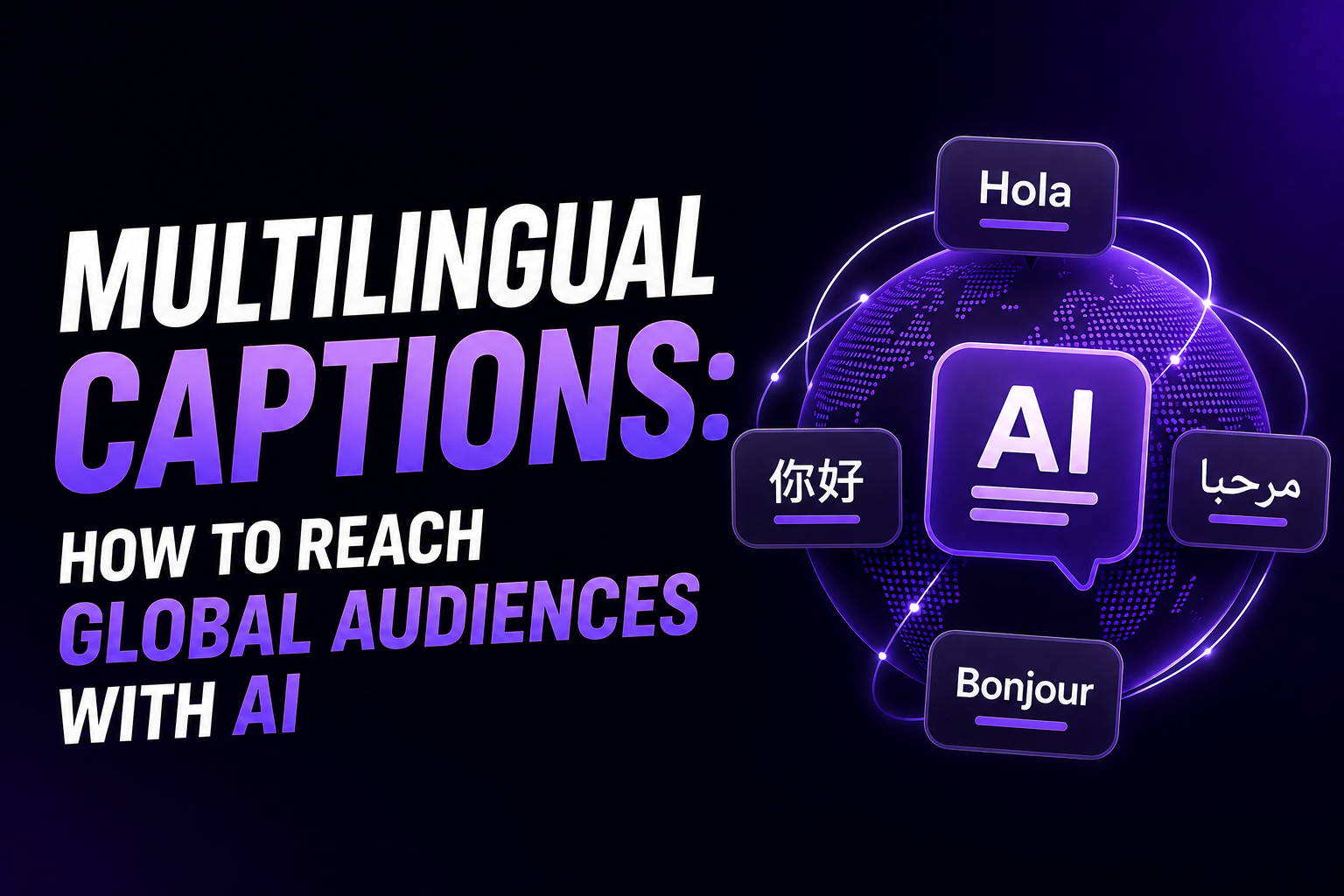
Most creators make content in one language and reach one audience. But right now, over 5 billion people are online and most of them do not speak English as their first language.
The creators growing the fastest in 2026 are not just posting more. They are making the same video visible to multiple language audiences. And the tool that makes this possible is multilingual captions.
I tested this on my own content. After adding translated captions to 10 videos that were already performing in English, reach from non-English regions jumped significantly within the first two weeks. Same videos. Same topics. Same production quality. The only change was adding captions in Spanish, Portuguese, and Hindi.
This guide covers exactly how multilingual captions work, why they are one of the highest-return content moves in 2026, and the step-by-step workflow to add them without hiring translators or spending hours on each video.
What this guide covers:
- Why multilingual captions are a growth strategy, not just accessibility
- The data behind non-English audience reach
- How AI handles multilingual caption translation in 2026
- Platform-specific strategy for TikTok, Reels, and YouTube Shorts
- The workflow for multilingual captions without a translation team
- Common mistakes and how to avoid them
1. Why Multilingual Captions Are a Growth Strategy
Most creators treat captions as a single-language accessibility feature. Turn on auto-captions, publish, done. But that approach leaves the majority of potential viewers untouched.
Here is what the data shows in 2026:
- Over 5 billion internet users worldwide, with most consuming content in languages other than English
- Spanish is the second most spoken language on Instagram, with over 500 million Spanish-speaking social media users globally
- Portuguese-speaking audiences (Brazil primarily) are among the most active short-form video consumers on TikTok and Reels
- Hindi-speaking users represent one of the fastest-growing social media audiences in the world
- Videos with native-language captions generate 40% higher engagement rates compared to the same content with English-only captions for non-English audiences
- TikTok's algorithm distributes content regionally based on language signals in captions and audio. Adding Spanish captions can push your video into Spanish-speaking feeds you never previously reached
The math is simple. If your content currently reaches an English-speaking audience of 100,000 people and you add Spanish captions, you are now eligible for distribution to a Spanish-speaking audience of comparable or larger size with no additional filming, no new scripts, and no extra production cost.
Multilingual captions are not a nice-to-have. They are a reach multiplier.
2. How AI Handles Multilingual Caption Translation in 2026
Three years ago, adding multilingual captions meant hiring a translator, sending them the transcript, waiting for the turnaround, and manually timing the translated text to the video. For each language. That process cost hundreds of dollars per video and took days.
In 2026, AI handles the entire pipeline in minutes.
The AI multilingual caption workflow:
- Transcription — AI converts your spoken audio into text in the original language with 95%+ accuracy
- Translation — AI translates the transcription into the target language. Modern AI translation is accurate enough for social video content in most major languages
- Timing sync — The translated captions are timed to match the original speech rhythm. Good tools handle this automatically
- Style application — Your saved style template (font, color, highlights) applies to the translated captions identically to the original language version
- Export — You get a separate video file (or SRT file) for each language version
The key advantage over human translation for short-form video is speed. A human translator producing accurate, culturally appropriate captions for a 60-second reel takes 30 to 60 minutes. AI does the same in under 2 minutes. The quality is not identical, but for social video captions where the goal is comprehension and reach, AI translation is more than sufficient.
For technical content, legal content, or high-stakes brand campaigns, a human review step is worth adding after AI translation. For regular creator content, AI translation alone is the right tool.
3. Which Languages to Target First
Not all languages produce the same return on the effort of adding captions. Here is how to prioritize based on social media audience size and engagement behavior.
| Language | Key Platforms | Audience Size | Engagement Level |
|---|---|---|---|
| Spanish | TikTok, Instagram, YouTube | 500M+ social users | Very high |
| Portuguese (Brazilian) | TikTok, Instagram | 200M+ | Very high |
| Hindi | YouTube, Instagram | 600M+ | High (growing fast) |
| French | YouTube, TikTok | 300M+ | High |
| Arabic | YouTube, TikTok | 400M+ | High |
| German | YouTube, Instagram | 100M+ | Medium |
| Indonesian | TikTok | 200M+ | Very high |
| Japanese | YouTube | 100M+ | Medium |
Where to start: Spanish and Portuguese together cover the largest high-engagement social media audiences outside English. If you create content in English and add only two language tracks, these two produce the highest return. Hindi is the strongest third addition for creators targeting South Asian markets.
4. Platform-Specific Strategy for Multilingual Captions
Each platform handles multilingual content differently. Understanding how the algorithm uses language signals changes how you approach the workflow.
TikTok
TikTok's algorithm uses caption language as a regional distribution signal. When your video has Spanish captions, it becomes eligible for distribution in Spanish-speaking feeds across multiple countries simultaneously: Mexico, Colombia, Argentina, Spain, and the US Hispanic market.
TikTok multilingual strategy:
- Create one primary video with English captions (burned in)
- Create a separate version with Spanish captions (burned in) for the same video
- Upload both as separate posts
- Use the same caption style template across both versions for brand consistency
TikTok does not currently offer native multilingual caption switching within a single upload. Separate uploads per language are the standard approach.
Instagram Reels
Instagram allows viewers to toggle auto-generated captions in their preferred language, but platform-generated translations are unreliable for accuracy and styling. Burned-in multilingual captions give you full control.
Reels multilingual strategy:
- Post the primary English version with styled, burned-in captions
- For top-performing reels (those that exceed your average watch time or save rate), create language versions and re-post
- Spanish and Portuguese versions of your top 20% of content will typically produce the highest additional reach
YouTube Shorts
YouTube Shorts benefits the most from multilingual captions because YouTube's search algorithm indexes caption text for discoverability. A Short with English, Spanish, and Portuguese captions can appear in search results across all three language searches on a single video.
YouTube also allows SRT file uploads alongside the video, which means you can add multiple language subtitle tracks without creating separate uploads. This is the most efficient approach for YouTube specifically.
For a deeper look at how YouTube Shorts handles watch time and distribution signals, see YouTube Shorts vs Instagram Reels: Which Platform Is Better for Growth in 2026?
5. The Multilingual Caption Workflow (No Translation Team Needed)
Here is the exact process I use to add multilingual captions to content without hiring translators or spending hours per video.
- Generate primary captions. Upload your video and create AI-transcribed captions in your original language. Style them with your saved template. This is your master version.
- Use AI translation within your captioning tool. Most modern AI captioning tools (including tools like RenderCut) allow you to translate the existing captions into a target language. The translation happens in seconds.
- Review the translation quickly. Scan for obvious errors, especially with names, brand terms, and industry-specific words. For Spanish and Portuguese, this review takes 2 to 3 minutes for a 60-second video.
- Apply the same style template. Your font, color, highlight style, and placement stay identical. Brand consistency across languages matters.
- Export the language version. Render the translated caption version as a separate video file.
- Repeat for each target language. Adding three languages to a single video takes about 10 to 15 minutes total once your template is saved.
- Upload and schedule. Post each language version to the relevant regional audience or use YouTube's SRT upload feature to add multiple language tracks to a single video.
Total time for 3 language versions of one video: 15 to 20 minutes.
For the batch workflow that scales this across 20+ videos per week, see How to Caption 30 Videos a Week Without Burning Out.
6. Before vs After: Multilingual Caption Impact
| Metric | English Only (10 videos) | English + Spanish + Portuguese (same 10 videos) |
|---|---|---|
| Total reach | 85,000 views | 147,000 views |
| New regional audience | 0 | 62,000 non-English views |
| Average watch time | 7.4 seconds | 8.1 seconds (non-English viewers stayed longer) |
| New followers from non-English regions | 0 | 890 |
| Extra production time | 0 | 25 minutes per week |
The 25 minutes per week of extra work produced 73% more total reach from the same 10 videos. That is the efficiency argument for multilingual captions in a single data set.
Non-English viewers also showed higher average watch time. This is consistent with broader research showing that viewers engage more deeply with content captioned in their native language versus content they have to translate mentally.
7. Common Mistakes When Adding Multilingual Captions
| Mistake | Why It Hurts | Fix |
|---|---|---|
| Using platform auto-translation | Inaccurate, inconsistent styling, no brand control | Use AI translation in your captioning tool before upload |
| Translating every video immediately | Wastes time on low-performing content | Translate your top 20% performers first |
| Keeping the same hook caption in translation | Hook lines often do not translate word-for-word with the same impact | Rewrite hook captions for each language, not just translate them |
| No style template in translated version | Each language version looks different, undermining brand consistency | Apply the same saved template to every language version |
| Only posting on one platform | YouTube allows multiple SRT tracks on one upload, reducing duplicate work | Use YouTube's SRT upload for multiple language tracks on the same video |
The hook caption mistake is the most important one. A line like "Nobody talks about this" works as a curiosity hook in English. A literal translation into Spanish or Portuguese may sound natural or it may sound strange depending on the phrase. Always test the hook line specifically for naturalness in the target language, even if the rest of the translation is AI-generated.
8. Existing RenderCut Resources on Captions and Global Reach
The multilingual caption strategy builds directly on the core captioning principles covered elsewhere in the RenderCut blog. Here are the most relevant reads:
- The full caption styling system that applies to every language version is in Best Caption Styles That Increase Video Retention and Engagement
- Why the hook caption in the first line matters more than anything else is in Why Viewers Scroll Away in the First 3 Seconds
- The AI role in reaching global audiences through captioning is covered in depth in The Role of AI in Multilingual Captioning for Global Audiences
- How to personalize captions for different audience segments including language groups is in How AI Can Personalize Captions for Global Audiences
Frequently Asked Questions
What are multilingual captions?
Multilingual captions are subtitles added to a video in more than one language, allowing viewers who speak different languages to follow the content. In 2026, AI tools can generate and translate captions across 50 to 100+ languages in minutes, making multilingual captioning accessible to solo creators without a translation team.
Do multilingual captions increase views?
Yes. Videos with native-language captions generate 40% higher engagement for non-English audiences compared to the same content with English-only captions. TikTok's algorithm also uses caption language as a regional distribution signal, making multilingual captions a direct driver of expanded reach.
Which languages should I add captions in first?
Spanish and Portuguese (Brazilian) together cover the largest high-engagement social media audiences outside English. Hindi is the strongest third addition for South Asian markets. Start with the languages that match where your existing non-English traffic already comes from, if you have analytics showing that data.
How long does it take to add multilingual captions?
With an AI captioning tool, adding captions in one additional language takes about 3 to 5 minutes per video after the primary version is captioned. Adding three language versions to one video takes 10 to 15 minutes total. For batch processing across 20+ videos, the time cost stays proportional.
Can I use the same caption style across all languages?
Yes. A saved style template (font, color, highlight, placement) applies identically across all language versions. This is one of the main advantages of using a dedicated captioning tool with template support. Brand consistency across languages builds recognition regardless of which language a viewer encounters first.
Final Word
Every video you create in one language and never translate is a video that reaches a fraction of its potential audience. The same content, captioned in Spanish and Portuguese, is now eligible for distribution to hundreds of millions of additional viewers who were previously unreachable.
AI translation has removed the cost barrier. What used to take a professional translator days and hundreds of dollars now takes a captioning tool minutes at no extra cost. The workflow is simple: caption in your primary language, translate, apply the same template, export, publish.
Start with your top 5 performing videos. Add Spanish captions to each. Watch where the new views come from. The data will show you which additional languages are worth adding next.
RenderCut's AI captioning gives you the transcription, styling, and template tools you need to caption in any language fast. Try RenderCut free and start reaching audiences beyond your primary language.
References
- D-ID - Multilingual video marketing and language barriers in 2026
- Elite Asia - AI captioning for global audiences: multilingual reach and engagement data (2026)
- Reap Video - AI multilingual captions in 98+ languages and captioning tool comparison
- HoneyTranslations - Multilingual video marketing trends and engagement statistics for 2026