
Content Repurposing System for Agencies Managing Multiple Clients
 RenderCutCreator Tips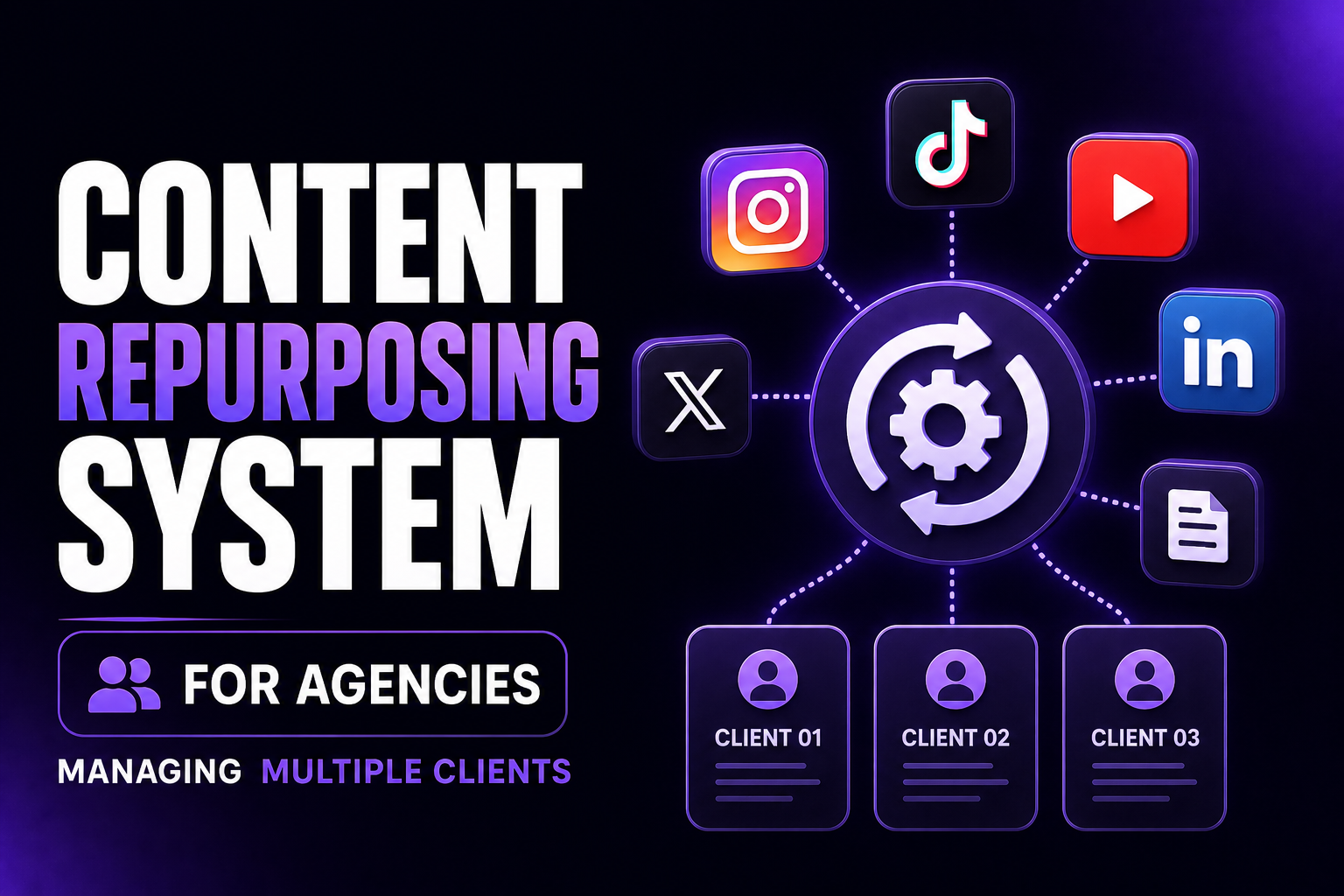
Agencies do not have a content problem. They have a systems problem.
Most repurposing workflows are built for one client. They work fine at three clients. By the time an agency hits ten or fifteen client accounts, the same process becomes reactive, inconsistent, and quietly eating into margins. Editors spend hours per video instead of minutes. Caption styles drift between clients. Turnaround times slip. The agency is technically delivering, but the operation is bleeding profitability with every new account.
A 2,000-word blog post or a single long-form video contains enough material to fuel a week of content across 8 to 12 platforms. The agencies winning in 2026 are not the ones creating more raw content. They are the ones who turned repurposing into a documented, repeatable system that scales without adding headcount for every new client.
This guide covers exactly how to build that system: the SOP structure, the client-specific template approach, the caption workflow that holds brand consistency across dozens of accounts, and the math behind why this is the highest-margin service an agency can offer.
What this guide covers:
- Why repurposing workflows break down at agency scale
- The SOP and tiered framework that fixes it
- Client-specific brand templates for captions and styling
- The repurposing math: time investment vs output multiplier
- Tools built for multi-client caption and video workflows
- Common mistakes that destroy agency margins
1. Why Repurposing Workflows Break at Scale
Repurposing workflows break down at scale because most agencies build them for one client, not twenty. A process that works when one person manages one account falls apart the moment that same person is managing caption styles, posting schedules, and brand voice for ten different clients simultaneously.
The three failure points agencies hit:
- No documented SOP. When the process lives in one editor's head instead of a written standard operating procedure, every new hire has to be trained from scratch, and quality varies based on who happens to be working that day.
- No tiered content framework. Treating every piece of client content the same way means high-value pillar content gets the same rushed treatment as a quick social post, and low-value content eats time that should go toward the work that actually moves client KPIs.
- No client-specific templates. Without a saved caption style, font, and brand kit per client, every video requires the editor to re-decide styling choices from scratch. This is the single biggest time drain in multi-client caption work.
Without a structured operations layer, content repurposing becomes reactive instead of systematic. The fix is not more tools. It is documented SOPs, tiered frameworks, and clear decision trees that any team member can follow without guessing.
2. The Repurposing Math That Justifies This as a Service
Before building the system, it helps to see why this is worth the investment. A well-researched blog post or a single long-form video typically takes 4 to 6 hours to produce. That same piece of content can be adapted across 8 to 12 platforms.
| Approach | Time Investment | Output |
|---|---|---|
| Creating 10 separate pieces from scratch | 40 to 60 hours | 10 pieces of content |
| Creating 1 pillar piece, then repurposing | 4 to 6 hours + 1 to 2 hours adaptation | 10+ pieces of content across platforms |
That is roughly 10 times more content distribution from a similar time investment. Repurposed content also generates 25 to 35% more engagement on average compared to platform-native content created from scratch, according to 2026 cross-platform performance analysis. For agencies billing clients on deliverables or retainer value, this efficiency gap is the entire profit margin of the service.
3. Building the SOP: A Repeatable System, Not a One-Off Process
The agencies that scale repurposing without breaking it document the process so thoroughly that any team member, including a new hire, can execute it without supervision.
What a repurposing SOP needs to cover:
- Source content identification. What qualifies as "pillar" content worth repurposing (a podcast episode, a webinar, a long-form video) versus content that does not justify the repurposing effort
- Clip selection criteria. A documented standard for what makes a moment worth extracting (a strong hook, a standalone insight, an emotional beat) so this decision does not depend on one editor's judgment
- Caption styling rules per client. Each client's brand kit, locked into a template, so applying it is a one-click decision rather than a fresh styling session every time
- Platform-specific export specs. Exact dimensions, safe zones, and caption placement rules for each platform the client posts to
- Review and approval workflow. A clear handoff point where a senior team member checks output before it goes to the client or goes live
Once this exists as a written document, training a new editor on a new client account takes a fraction of the time it would take to build understanding through trial and error.
4. Client-Specific Caption Templates: The Core of Multi-Client Consistency
The single biggest lever for agency efficiency in caption work is the saved style template, applied per client.
Every client should have their own locked template covering:
| Template Element | What to Lock In |
|---|---|
| Font family and weight | Matches each client's brand guidelines |
| Caption color and highlight color | Brand-specific palette, consistent across every video |
| Chunk length | 3 to 5 words per line as a baseline, adjusted for client content style |
| Placement and safe zone | Tuned to the platforms that specific client posts on most |
| Hook caption tone | Bold and punchy for one client, calm and authoritative for another |
Once a client's template is built and saved, every video for that account applies the same look with one click. This is what separates an agency that looks consistent and professional across every deliverable from one where quality fluctuates based on who edited which video.
The foundational system behind why this styling approach drives retention (not just brand consistency) is covered in Best Caption Styles That Increase Video Retention and Engagement. For the batch process that applies these templates at volume, see How to Caption 30 Videos a Week Without Burning Out.
5. The Agency Repurposing Pipeline (Step by Step)
Here is the full pipeline from one piece of client source content to a multi-platform output package, structured for repeatability across accounts.
- Identify pillar content. A podcast episode, webinar recording, or long-form interview from the client that contains multiple standalone moments
- Run AI clip detection. Use an AI clipping tool to extract 15 to 25 candidate short clips from the source video
- Apply selection criteria from the SOP. Keep the clips that meet the documented bar for hook strength and standalone value, typically the top 15 to 20
- Move clips into the captioning tool. Apply the client's saved style template in one click across the full batch
- Write custom hook captions per clip. AI clipping tools extract moments that often start mid-thought. Every clip needs a manually written first line, even at agency scale
- Chunk and highlight per the SOP standard. 3 to 5 word segments, one highlighted keyword per chunk, consistent with the client's locked template
- Export and quality check. A senior reviewer checks the batch against the client's brand standard before anything goes live or to the client for approval
- Schedule across platforms. Distribute according to the client's platform mix and posting cadence
For agencies handling multiple clients in parallel, this pipeline runs as a queue: source content comes in from any client, gets logged, and moves through the same documented steps regardless of which account it belongs to. The deeper breakdown of turning one long video into many shorts is in How to Turn One Long Video Into 20 Shorts Using AI.
6. Tools Built for Multi-Client Workflows
Not every tool supports the template-per-client structure agencies need. Here is what to look for.
| Feature | Why It Matters for Agencies |
|---|---|
| Multiple saveable style templates | One template per client, switchable instantly |
| Fast batch processing | Process clips for several clients in one working session |
| Word-level caption control | Brand-specific highlight colors and emphasis per client |
| No per-video subscription cost scaling | Lifetime or flat pricing keeps margins predictable as client count grows |
| Clean export without watermarks | Required for any client-facing deliverable |
A subscription-based tool that charges per seat or per video volume can quietly erode agency margins as the client roster grows. A tool with flat or lifetime pricing keeps the cost structure predictable regardless of how many clients or videos move through the pipeline. The full tool comparison is in Opus Clip vs Submagic vs RenderCut: Which Tool Is Best for Short Videos.
7. Common Mistakes That Destroy Agency Margins
| Mistake | Why It Hurts Margins | Fix |
|---|---|---|
| No documented SOP | Every new hire trained from scratch, inconsistent quality | Write the process down once, train against the document |
| Same workflow for every client regardless of value | High-effort clients get the same treatment as quick wins, wasting senior time | Tier clients and content by value, allocate effort accordingly |
| Rebuilding caption styles per video | Massive time waste across dozens of videos per week | Build and lock one template per client |
| Subscription tool costs scaling with client count | Profitability shrinks as the agency grows, the opposite of the intended outcome | Choose tools with flat or lifetime pricing for caption work |
| No quality review step before client delivery | Errors reach the client, damaging trust and creating rework | Add a single senior review checkpoint before anything ships |
The margin-destroying mistake most agencies do not see coming is the third one. Rebuilding caption styling decisions for every video, multiplied across every client, multiplied across every week, is the single largest hidden time cost in agency content operations.
Frequently Asked Questions
How do agencies repurpose content at scale without losing quality?
Agencies maintain quality at scale by documenting a clear SOP, building client-specific caption and brand templates, and adding a single review checkpoint before content ships. The system removes guesswork from repetitive decisions (styling, clip selection, export specs) so quality stays consistent regardless of which team member handles a given client.
What is the biggest time waster in agency content repurposing?
Rebuilding caption styling decisions from scratch for every video is the largest hidden time cost. Without a saved template per client, editors re-decide font, color, highlight style, and placement on every single video, which compounds into significant wasted hours across a multi-client roster.
How much content can one piece of source material produce?
A single long-form video or in-depth blog post typically contains enough material to produce content across 8 to 12 platforms. This represents roughly 10 times the output of creating each piece from scratch, for a fraction of the additional time investment.
Does repurposed content perform as well as platform-native content?
Yes, often better when properly adapted. Repurposed content generates 25 to 35% more engagement on average compared to content created from scratch for each platform, according to 2026 cross-platform performance data, provided the repurposing includes platform-specific adaptation rather than a direct copy-paste of the same format everywhere.
What tools should agencies use for multi-client caption work?
Agencies should prioritize tools that support multiple saveable style templates (one per client), fast batch processing, word-level caption control, and pricing that does not scale unpredictably with video volume or client count. Lifetime or flat-rate pricing protects margins as the client roster grows.
Final Word
The agencies that scale past ten or fifteen clients without their content operation collapsing are not the ones with the most editors. They are the ones with a documented system: a clear SOP, a template locked per client, and a pipeline that turns one piece of source content into a full multi-platform package without reinventing the process every time.
The repurposing math alone justifies building this system. Ten times the content output for a fraction of the additional time. But that math only holds if the repetitive decisions, especially caption styling, are systematized instead of remade from scratch on every video for every client.
Start by documenting your current process, even if it feels obvious. Build one saved caption template per client. Run your next batch of client content through the full pipeline and time it. The gap between your current process and a systematized one will be immediately visible in both hours saved and consistency delivered.
RenderCut supports multiple saved style templates, word-level caption control, and lifetime pricing that does not scale with client count, making it built for agency-volume caption work. Try RenderCut free and build your first client template today.
References
- Growth Rocket - Scaling client accounts without breaking repurposing workflows: SOPs, tiered frameworks, and margin protection (2026)
- InfluenceFlow - Repurposing content across multiple platforms: the complete 2026 guide and engagement data
- Postiv AI - 8 best AI content repurposing tools in 2026, tested with pricing for agency use
- SocialPilot - White label content creation: complete agency guide for 2026